
Custom design case | Nitrogen-purge ESD box
The customer asked for 6 kg, and we built 22 kg — why?
The weight of an airtight box is calculated, not called out. The weight of a custom airtight box is not set by anyone’s wish; it is calculated from three physical conditions: how much it must hold, how much pressure it must withstand, and which functions it must have. This article uses a real case (the customer’s identity is confidential) to walk through how Jiahon accompanied a customer in converging a requirement that “had not yet been fully defined,” step by step, into a solution that can be built and can be accepted.
The starting point was typical. The customer wanted to carry in-process material between plant buildings, and wanted a batch of sealed carrying boxes that could be filled with nitrogen and were anti-static, on the scale of a few dozen units. The customer supplied the dimensions of three standard carriers (including the FOUP front-opening unified pod common in 12-inch wafer fabs), a desired outer box size, and one sentence: “it must be sealed, and anti-static.” There was no acceptance criterion, no test method, and no weight limit. (Further reading: How to choose semiconductor totes and ESD trays.)
This was not the customer’s oversight. It is the normal state of custom requirements: the problem itself has not yet been defined. Our work starts from there.
First gate: work out whether it fits
The first thing on receiving the requirement is not a quotation. It is to place each of the three carriers’ dimensions into the outer box the customer specified and work out the usable interior space left after deducting wall thickness, the sealing flange, and the air-guide space at the bottom.
The result: the box height the customer specified was about 15% shorter than the tallest item to be held, and the width was short by a few centimeters as well. It was not that machining could not do it; geometrically it would not fit, even with zero wall thickness.
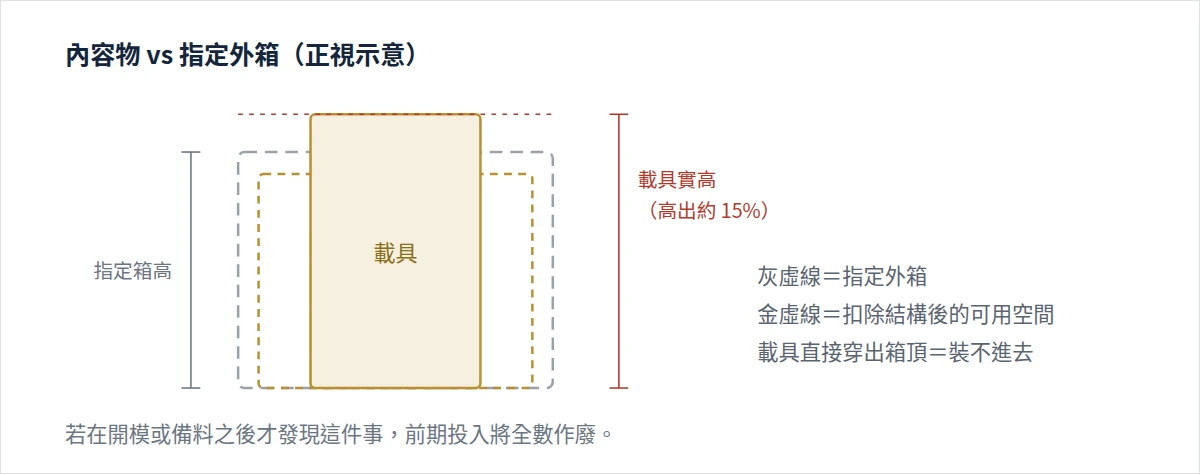
Figure 1: Dimensional envelope check — in any custom container project, the first step is always to confirm “will it fit.”
This step sounds basic, but it is the point in the whole project where the more costly mistake occurs: if you find out after the tooling is cut and the material is bought that it does not fit, all the earlier investment returns to zero. So Jiahon’s habit is to run the envelope check on the day the drawing arrives, and everything else is lined up behind it.
After “cannot be done,” give a route that can be
Early in this project there was another turn: the customer first hoped the box would be evacuated and then backfilled with nitrogen. Our engineering assessment was direct — it cannot be done. Under vacuum, the box has to bear a full atmosphere of external pressure, and for a box of this size to stay undeformed, wall thickness and weight would get out of control.
But “cannot be done” must not be a full stop. At the same time we proposed an alternative route:
Switch to micro-positive-pressure nitrogen purge — make the pressure inside the box just slightly higher than outside. As long as the pressure difference runs from inside to outside, outside air cannot seep in, and the aim of preventing oxidation is the same; yet the pressure the box bears falls from a full atmosphere to about one twentieth of an atmosphere (+5 kPa), and the structural limit disappears at once.
Saying “no” is easy; anyone can. The value of professionalism is the next sentence: “But if we change it to this, it works.” The customer did in the end adopt this route.
The 6 kg dream, the 116 kgf reality
Midway through the project, the question in this article’s title appeared. The customer took a commercial plastic storage box for comparison: “This one is just 6 kg. Why must yours be over 20? Can you make it 6 kg too?”
This is a good question, and deserves an answer by calculation, not by position.
The precondition of sealing is that the sealing ring is pressed continuously all the way round. For a box of this size the sealing ring runs close to two meters all round. Fill with nitrogen to +5 kPa — how small is that pressure? It equals roughly just the water pressure at 50 cm depth — yet the lid has to bear about 116 kgf pushing upward.
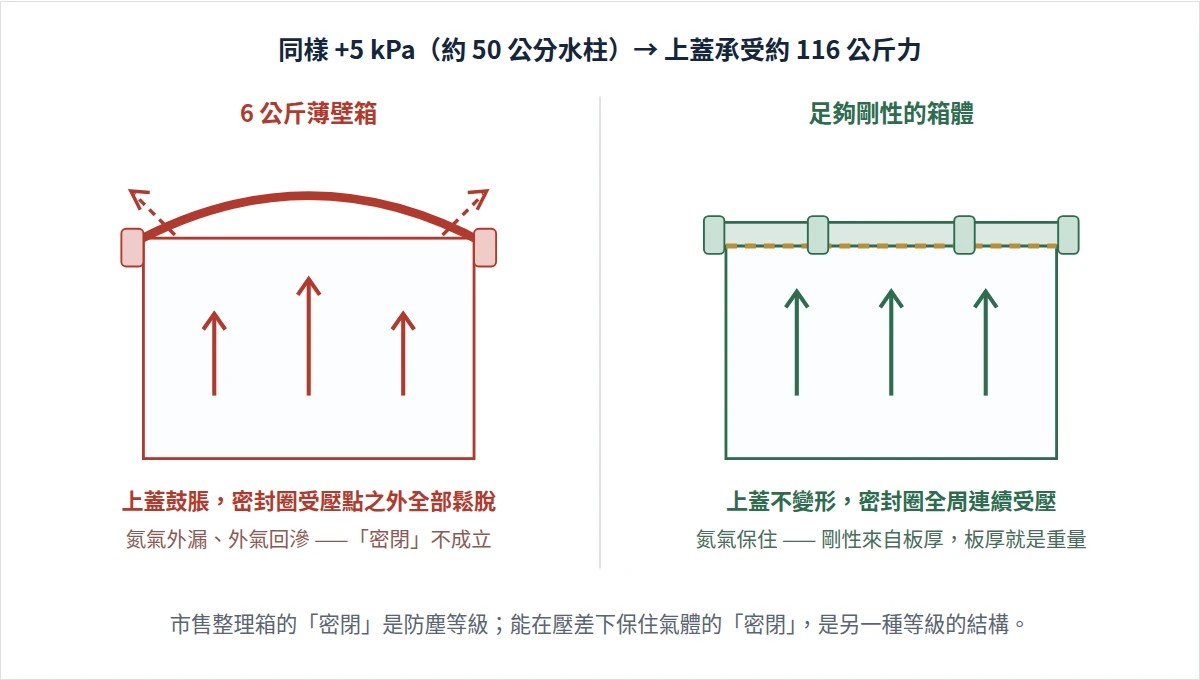
Figure 2: The same 116 kgf; the difference between the two boxes is just one thing — whether they can stand it.
That force sets the lower limit of the wall thickness, and thickness is weight. Converting the plate thickness each material needs to “stand it,” the answer is as follows:
| Material | Plate thickness required by mechanics | Shell weight | Whole-box weight lands at | Notes |
|---|---|---|---|---|
| Stainless steel SUS304 | About 1.5 mm | About 16 kg | About 22 kg | No tooling needed, welded airtight; suits small-volume custom work |
| Aluminum alloy | About 2.5 mm | About 10 kg | About 17 kg | Lighter; airtight welding is more demanding |
| Engineering plastic | About 5~7 mm | About 9~11 kg | About 15~16 kg | Needs tooling; spreading the tooling cost over a few dozen units is not economical |
The above are approximate values from equal-stiffness conversion; this is the general case, and individual cases still have to be judged on their own.
Many people assume intuitively that “switching to plastic makes it several times lighter” — but plastic is far less stiff than metal, and to bear the same force it has to be several times thicker, so the weight advantage is left at just about thirty percent.
What 6 kg buys is “a box with a lid,” not “a box that holds nitrogen.” If a 6 kg airtight box could be made, companies with deep tooling pockets would have made it long ago.
Where the weight comes from: function is weight
Next the customer did something we admire: they took a red pen to the design drawing and went item by item, asking “can this be removed?” It was a serious engineering discussion, and we answered each item seriously — some really could be removed; for some, removal makes the function disappear with it; and for one, removal would make the whole box heavier instead.
| Function | Corresponding component | Weight | What happens if removed |
|---|---|---|---|
| Sealing | Sealing flange, stiffening frame, pressure-equalizing quick latches | About 4 kg | The lid is pushed open by internal pressure, and even the dust-tightness rating no longer holds |
| Nitrogen filling | Four valve ports, relief valve, air-guide design | About 1.5 kg | Nitrogen cannot be filled, or blows straight onto the material |
| Anti-static and positioning | Static-dissipative contact surfaces, grounding path, carrier positioning parts | About 1 kg | The metal box becomes an “isolated conductor” and fails the static audit; carriers slide and collide inside the box |
| (The box itself) | Shell | About 16 kg | — |
This is the general case, and individual cases still have to be judged on their own.
The arithmetic is clear: even if the components of all three functions were removed, just about 6.5 kg would be saved — what remains is still a 16 kg bare shell, far from 6 kg. More than seventy percent of the weight is in the shell, and the shell thickness is set by that 116 kgf force, not by any accessory. In the actual discussion, the genuinely reasonable reduction was about 1.5 kg (the pressure indicator and air-guide parts, and the quick latches cut to the lower limit for sealing and pressure equalization), and we also held off two “save a little, lose a lot” cuts — with one of them removed, the space for loading and unloading would have had to be enlarged, and the whole box would have grown instead of shrinking. The interesting one is grounding: the part is cancelled, the function stays — the grounding path is merged into an existing structural stud, adding zero weight, and it can be verified against the grounding requirements of ANSI/ESD S20.20.
A specification with no acceptance criteria hurts both sides once signed
From beginning to end of this project, the end customer gave one requirement: “airtight and anti-static.” That is very common in custom projects — but the word “airtight” cannot be accepted against: what pressure? left standing how long? how much loss is allowed? Without numbers, delivery day is the start of both sides saying different things.
So Jiahon does two things together:
Draft an acceptance standard first, on our own initiative — dimensional tolerances, weld requirements, static values, valve-port position accuracy, each written at a level that can be measured and that a general machining system can carry out, to give the customer a basis for discussion rather than waiting for the customer to produce one.
At the same time, list the “items not committed” explicitly — leak-rate values, oxygen-content values, and cleanliness class, which need special test equipment or cleanroom conditions, are written down in black and white: not committed in this project; if they are to be included in acceptance, please supply the test standard and method, and we will assess separately.
A specification that dares to write “not committed” is the specification that protects both sides. A supplier who agrees to everything is not especially capable; it just has not yet thought about delivery day.
What the customer did not ask, and we added on our own
During the structural assessment, we found a problem that the initial requirement did not mention but that would certainly occur on site: an airtight box of this class weighs more than 30 kg once loaded, already above the recommended weight for manual handling — and in the initial plan, the loading and unloading stage was done by people.
We did not wait for the customer to discover it. We added a section to the specification directly: it recommends that the box stay on a trolley the whole way, with personnel just opening the lid and placing material, not touching the box; and it is designed on the “fill at the station, close the valve, and take it away” principle — using the directionality of micro positive pressure (the inside is always higher than the outside, so air cannot seep in), a short move does not even need the nitrogen cylinder to follow, which removes at once the regulatory management of high-pressure gas cylinders, periodic inspection, and elevator carrying limits.
This section states clearly: “outside the initial requirement scope; not adopting it does not affect the quotation for the box itself.”
Half of the value of custom design is in the questions the customer asks, and the other half is in the questions the customer has not yet thought of.
How we open a project: four steps, the same for every case
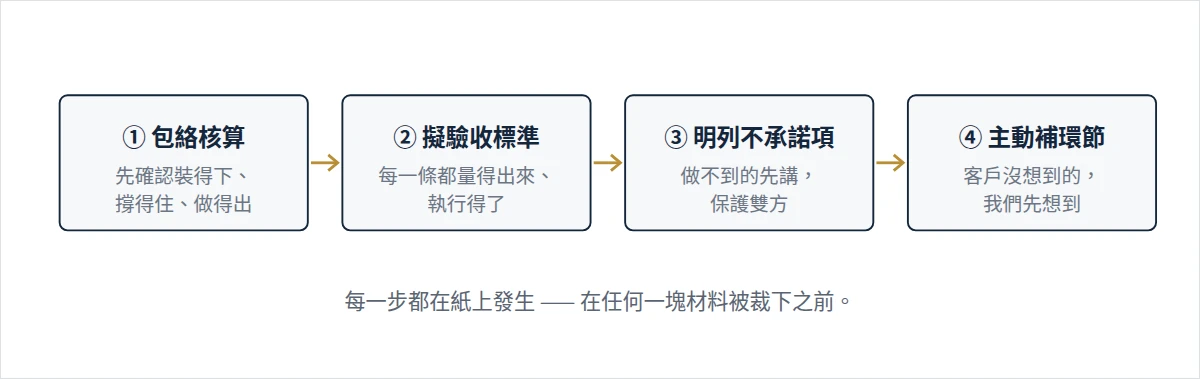
Figure 3: Jiahon’s method of opening a custom project — converging a “requirement not yet fully defined” into a solution that “can be built and can be accepted.”
Where this case ended up is not the point — the point is that this way of working is the same in every case: first mark out the feasible interval by calculation, so the customer sees the whole picture before making any decision. The gap between dream and reality is not there to talk the customer out of it; it is to be taken apart item by item and converged item by item.
You are welcome to bring a concept that is still taking shape to discuss, so that your cost down plan can land, and so that yield improvement is no longer just a dream. It is fine if you have just a sketch, a photo, or even just a few dimensions — most custom projects start that way. We can start from the dimensional check, tell you first where the feasible interval is, and then discuss whether to do it.
Get to know Jiahon’s four business units
See also