
Surface resistance standard: the key figure for selection
Acceptance rests on two things: when you choose an ESD table mat, the surface resistance must fall in 10^6–10^9 Ω; color alone, or the label “anti-static,” is not enough — the actual resistance value must be measured before the mat counts as passed. The ground cord is the sole exit for static to drain away; without it, even a good mat is just decoration.
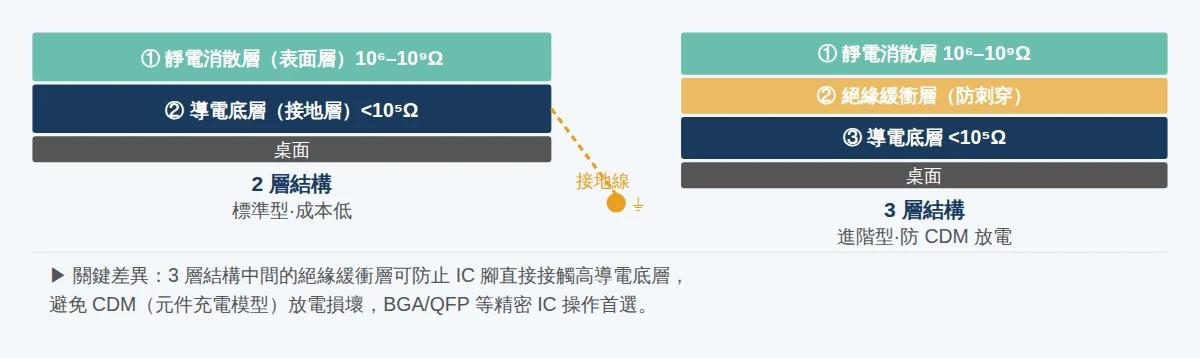
Figure: cross-section comparison of 2-layer and 3-layer anti-static table mats (illustration).
ANSI/ESD S20.20 requires both the point-to-point resistance and the resistance to ground (RTG) of an ESD work surface to be below 1×10^9 Ω (measured by ANSI/ESD STM4.1, formerly numbered S4.1); if you are worried about CDM damage, a lower limit of 1×10^6 Ω is recommended. A figure too low (<10^5 Ω) causes discharge that is too fast and damages components; a figure too high (>10^11 Ω) is the same as an insulator, and static cannot drain away at all.
| Class | Surface resistance (Ω) | Characteristics | Where used |
|---|---|---|---|
| Conductive | <1×10^4 | Discharges extremely fast; too fast may damage ICs | Grounding tools, fixture stands |
| Static dissipative | 1×10^4 to <1×10^11 (a work surface must be <1×10^9, and we suggest not below 1×10^6) | Drains static at a controlled rate, safe | The standard range for an ESD work mat |
| Antistatic | Not graded by resistance | Refers to the property of low charging (not easily charged by friction) | Outer packaging bags, protective bags |
| Insulative | ≥1×10^11 | Static cannot drain away | Not for ESD work areas |
A common misunderstanding: a green or blue mat does not mean it meets the ESD standard. Color is just habit and has nothing to do with resistance. Before acceptance, always measure with a surface resistance meter (SRM-110 or equivalent); a value falling within 10^6–10^9 Ω counts as passed.
2-layer vs 3-layer: how to choose?
| Item | 2-layer structure | 3-layer structure |
|---|---|---|
| Structure | Dissipative layer + conductive bottom layer | Dissipative top layer + conductive middle layer + dissipative foam bottom layer (vinyl type); or dissipative top layer + foam cushion layer + conductive bottom layer (rubber type) |
| CDM protection | The same for both: depends on the lower resistance limit (suggested ≥1×10^6 Ω), with no direct relation to the number of layers | |
| Corresponding components | DIP, ordinary SMD | BGA, QFP, high-pin-count ICs |
| Durability | Standard | Better (the layers protect the surface) |
| Price (as listed in the specification table) | Low | Medium to high |
| Suggested choice | Ordinary repair stations, warehouse stock areas | SMT/SMD precision work benches, IC test stations |
Grounding method: the sole exit for static
However good the mat, without correct grounding it is zero protection. The standard practice:
Ground cord specification: use an ESD ground cord with a 1 MΩ series resistor, to prevent excessive current in case of a short circuit.
Grounding point: connect to a common point ground, then to the equipment ground (the ground wire of the third hole of the socket, the preferred option recommended by ANSI/ESD S6.1); if a separate independent ground is used, it must be equipotentially bonded to the equipment ground wire.
Installation: fix the ground snap to the conductive layer at the bottom of the mat, and do not pull the cord tight; leave some slack.
Acceptance frequency: we suggest measuring RTG (point-to-ground resistance) with an SRM every quarter, to confirm it is <1×10^9 Ω.
Quick acceptance procedure: place the electrodes on any two points of the mat surface (25 cm apart) and measure the PTP resistance; then move one electrode to the end of the ground cord and measure the RTG resistance. If both are below 1×10^9 Ω (we suggest not below 1×10^6 Ω), the mat meets the ANSI/ESD S20.20 requirement for a work surface.
Jiahon’s Anti-Static Table Mat / Table Cloth is made of static dissipative material, with surface resistance measured to ANSI/ESD STM4.1 and meeting the ANSI/ESD S20.20 requirement for work surfaces, for all kinds of electronics manufacturing benches and repair stations. If you need an overall static partition plan with Anti-Static PVC Door Curtains, or Static Wrist Straps to form a complete body grounding loop, inquiries for a quote are welcome.
For how to choose the mat’s material, surface resistance, and grounding, first read How to choose an anti-static table mat? Material, resistance, grounding, and size at a glance.
Also see | Complete protection setup for an ESD workstation
Need a quote or want to confirm a specification? Inquiries are welcome: Request a quote now