
Laying out an SMT maintenance schedule means sorting each station’s maintenance items into four boxes — weekly, monthly, quarterly, yearly — and then writing, for every item, how to do it, the pass value, what to do when it is exceeded, and where the record goes. Take the draft of items and intervals from each equipment maker’s manual (the maintenance chapter) first; what the schedule has to do is turn it into one sheet that people on the floor can understand, finish, and look up afterwards.
First, the source and the limits of the material: this article draws on older material we consulted earlier, including a 2009 SMT equipment maintenance item list (which splits the items of the printer, mounter, reflow oven, AOI and flux cleaning machine into weekly, monthly, quarterly and yearly), four station-by-station maintenance work specifications from 2007 to 2009, one oven maintenance specification, one PM specification for a fixture cleaning machine, and one 2013 weekly report of an equipment section. These documents are old and the models differ from today’s; what we borrow is “how to split and how to record”, not the standard intervals of any model. For your machines, follow the equipment maker’s manual.
1. The whole picture first: 5 steps to lay out a maintenance schedule
Q: How do I lay out a maintenance schedule from scratch? A: In five steps: take the draft, split it into boxes, fill in the content, set the rules, and link spare parts. The table below is the skeleton of the whole article, and each section after it matches one step:
| Step | What to do | Section |
|---|---|---|
| 1 Take the draft | From the maintenance chapter of each maker’s manual, list the items and recommended intervals | Section 2 |
| 2 Split into boxes | Sort each station’s items into weekly, monthly, quarterly and yearly | Section 3 |
| 3 Fill in the content | For each item add how and with what tool, pass value, what to do when exceeded, and how to record | Section 4 |
| 4 Set the rules | Grace periods, estimated downtime, conditions that require a stop | Section 5 |
| 5 Link spare parts | For items that change parts, write down “what to change and how many”, and work out spares from the records | Section 6 |
2. Step 1: intervals come from the manual, then adjust to output
Q: How do I set maintenance intervals? A: First copy the maintenance chapter of the equipment maker’s manual, then adjust to your own output and conditions. Of the four station specifications we consulted, three — printer, mounter and reflow oven — say “maintenance items and frequency follow chapter 7 (maintenance) of the equipment maker’s manual”, and the specification itself covers just “how to do it”; the AOI one separately lists weekly, monthly and half-yearly items and lists the equipment maker’s maintenance manual as a reference document. In other words, the source of the interval is the manual, and the job of the specification is to turn the manual into steps that can be carried out.
Equipment makers themselves are moving towards “going by condition”: Yamaha’s official SMT page divides maintenance into the three goals of speed, quality and labour saving, mentions using the nozzle health check to clean when signs of failure appear, and using a data board to show which feeders, heads and nozzles need attention (Yamaha SMT: maintenance concept page; the page lists no interval figures and shows no date, so it is used just as the maker’s philosophy).
Another example comes from reflow ovens: the IPC website carries a technical paper by a reflow oven maker (a paper on removing reflow volatiles by an author from Vitronics Soltec; the page gives no year), which mentions the gas circulation system of a high-volume nitrogen line, with an interval of 4 weeks between two maintenance sessions, cleaning after about 50,000 to 90,000 boards soldered, each stop taking 2 hours with 2 technicians. What it wants to show is that the interval is often tied to output and the amount of solder paste residue, and is not a fixed number on the calendar. It is a paper published by the equipment maker itself, and the numbers are used just as an order of magnitude.
3. Step 2: station × week/month/quarter/year — what a 2009 table looked like
Q: Roughly how are the items of five stations split into weekly, monthly, quarterly and yearly? A: The table below is the 2009 maintenance item list we consulted, 40 items in all. The source file is one presentation page with one column for each of the five stations, and the interval is not shown by column but by text colour (legend: black = weekly, dark orange = monthly, teal = quarterly, light orange = yearly); we restored it into a table by matching the colour codes inside the file against the legend. No other document lets us cross-check the intervals item by item, so please treat it as “how one set of material laid it out in its day”.
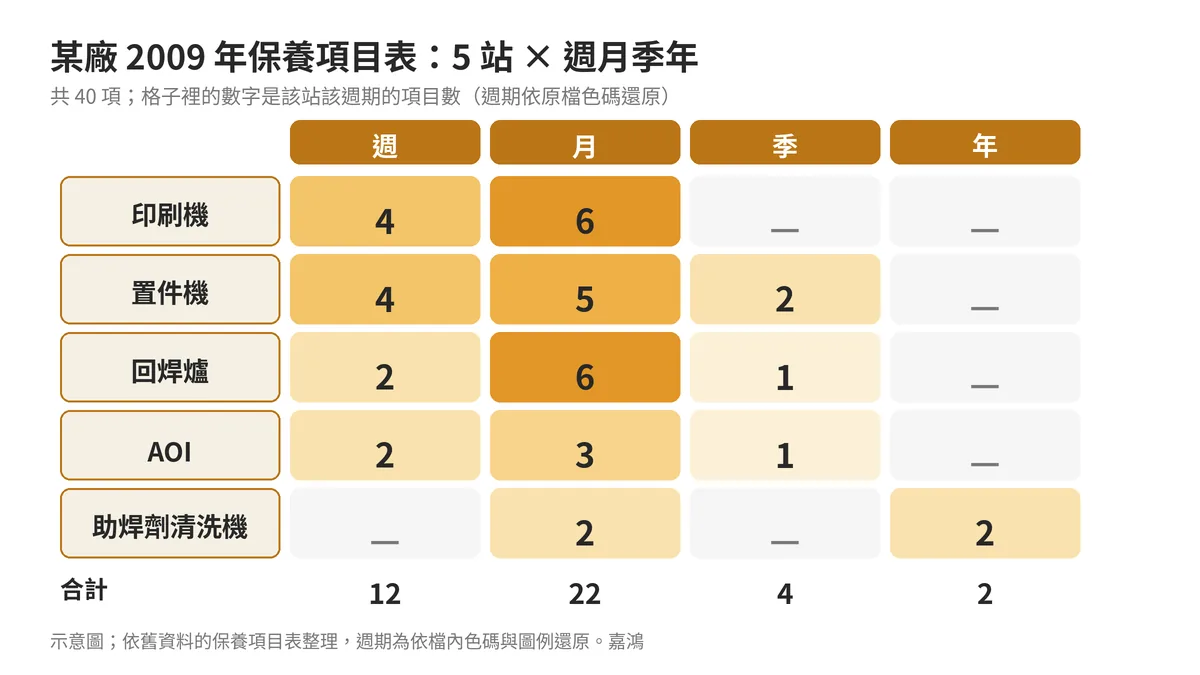
Schematic: the number of items per interval in one factory’s 2009 maintenance item list (intervals restored from the colour codes in the source file).
| Station | Weekly | Monthly | Quarterly | Yearly |
|---|---|---|---|---|
| Printer | Squeegee state sensor cleaning; cleaning fluid check; lift fixture cleaning | Print head, squeegee set, camera X/Y axes, rails and lift axis, each cleaned and lubricated (this row contains 4 items); drive belt condition and tension; vacuum set cleanliness | — | — |
| Mounter | Conveyor rail cleaning; camera lens cover glass cleaning; machine and reject box cleaning; nozzle holder inside and outside cleaning | Conveyor belt and roller check; linear rail and ball screw greasing; nozzle tip and interior cleaning; feeder cleaning and operation check; whether support pins are deformed | Lubrication of the support unit of the board clamp upper-limit stopper; transfer head filter cleaning | — |
| Reflow oven | Flux filter check; pure water level check | Conveyor width axis and lead screw check; lubrication of conveyor chain, width axis and lead screw; cooling zone pipe filter check; oven chamber and condenser cleaning; conveyor belt and drive system cleaning; chain oil level check | Pure water filter element check | — |
| AOI | Camera RGB adjustment; O-ring position check | LED lights around the camera check; positioning spring check; drive belt condition and tension | Rail system cleaning and lubrication (the source file notes “2 quarters”, which we read as once every two quarters) | — |
| Flux cleaning machine | — | Filter cleaning; water filter and parts cleaning | — | Deionized water tank cleaning; air filter replacement |
We counted item by item: weekly 12, monthly 22, quarterly 4, yearly 2. Below is how we read it; please take it as reading notes, not conclusions of the source file:
Weekly: mostly cleaning and state checks that you can wipe and see, such as conveyor rails, lens covers, reject boxes, nozzle holders, flux filters and pure water level.
Monthly: lubrication, belts and filters start to appear, along with the reflow oven’s chamber and condenser, and mostly tools are needed.
Quarterly and yearly: just 6 items, mostly filters, lubrication and water tanks.
Two reminders. First, this table is alive: another document, the 2013 equipment section weekly report, splits the mounter’s PM into six levels L1 to L6, the last being “head assembly major service (annual maintenance)”, while the mounter in the 2009 table has no yearly item; the two are four years apart, and the layout changes with time. Second, we read the AOI’s “2 quarters” as once every two quarters, which agrees with the “weekly, monthly, half-yearly” tiers of another AOI specification.
The older material also had an oven maintenance specification (an oven is not SMT equipment, but the way of splitting can be borrowed): the quarterly service has 6 items, checking the intake and exhaust ducts, the screws in each part, clearing the vents, the temperature test terminal cover, the oven program and temperature profile, and the temperature of the constant-temperature zone; the yearly service has 5 items: the distribution panel, blower impeller, blower motor, over-temperature protector and temperature sensing wire. Our reading: the quarterly checks are mostly things you can see and measure, the yearly checks lean towards electrical and rotating parts, and when laying out the schedule, leave a longer downtime for them.
To look back at what happens when maintenance is not enough, compare with Nozzle pick failure and thrown parts, Poor feeder feeding and jams: how to troubleshoot and How to troubleshoot reflow soldering defects: they are about “how to find out what broke”, and this article is about “how to lay out the routine”.
4. Step 3: write every item so that it can be finished and looked up
Q: What should be written for each item on the maintenance schedule? A: Five things: the item, how and with what tool, the pass value, what to do when exceeded, and how to record. The older mounter maintenance specification writes almost every item in this format. The three examples below come from the same specification:
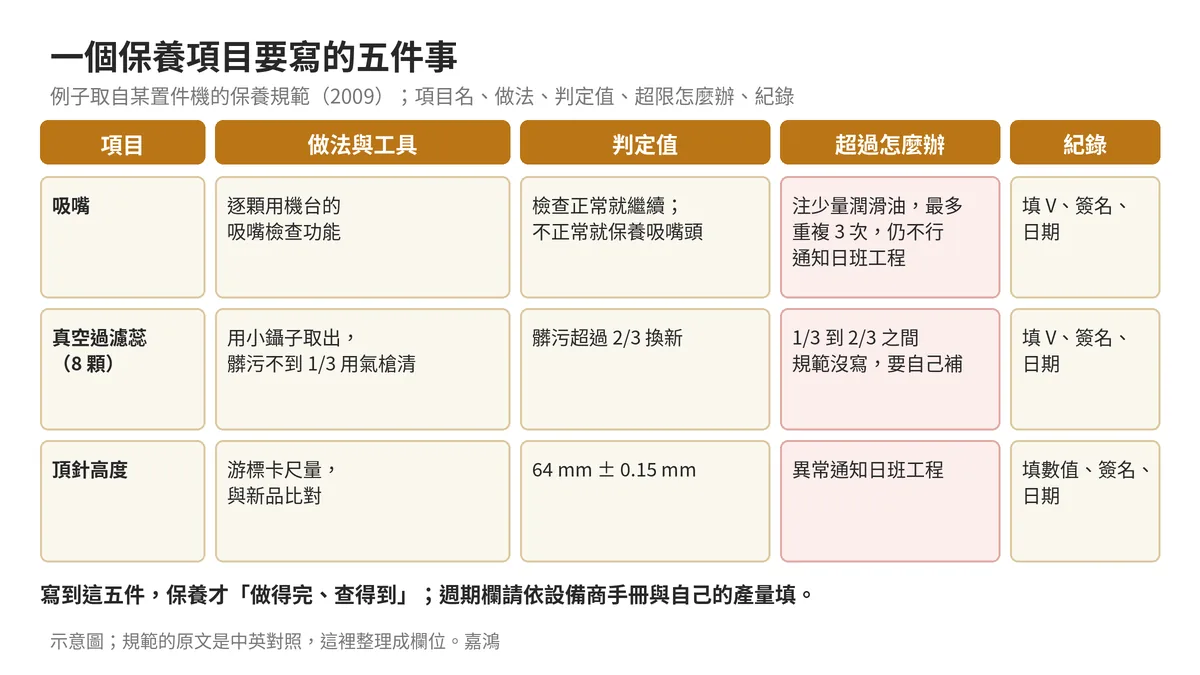
Schematic: the five things to write for a maintenance item (examples from one mounter’s maintenance specification).
Nozzles: check each one with the machine’s nozzle check function; if normal, carry on; if not, inject a little lubricating oil at the nozzle tip, repeat at most 3 times, and if still not working, notify day-shift engineering.
Vacuum filter elements (8 in all): take them out with small tweezers; if dirt is under 1/3, clean with an air gun; if over 2/3, replace with a new one. The specification does not say what to do between 1/3 and 2/3, and that is a place where you must “fill in yourself”.
Support pin height: measure with vernier calipers and compare with a new one; the pass value is 64 mm ± 0.15 mm; notify day-shift engineering if abnormal.
The reflow oven specification is written in more detail: put the condenser in an ultrasonic bath, add 20 litres of isopropyl alcohol, wash for 30 minutes at intensity 5, and confirm the flux is washed off, re-wash if it is not; after refitting, run the cooling program for 30 minutes, then the 150°C program for 30 minutes. For the drive chain, stick on heat-resistant tape, set the chain speed to 30 cm/min, go round once and look for damage by eye, and if damaged stick on a red label and notify day-shift engineering. The common pattern is “what to do, how to judge, whom to call when exceeded”.
At the end of each specification there is a pointer to a “record sheet”: the items are confirmed one by one at their frequency, with values filled in or a V ticked after doing it, then signed and dated. The printer specification lists a monthly maintenance record sheet alone, and the mounter and AOI have their own weekly, monthly, quarterly or weekly, monthly, half-yearly record sheets. The record sheet itself also gets picked on: the older material has a 2012 audit finding in which the mounter’s check sheet was listed for improvement, the risk being written as “it is hard to see the PM status”, and the corrective action was to change the record sheet.
Q: Will parts not listed on the sheet be missed? A: Yes, and for a long time. The older material has a yield report (2013): a wire bonder (not SMT equipment) had insufficient vacuum, traced to a ruptured vacuum hose; the report states that this hose had been used for 22 months but “was not listed in the PM items”, so it could not be found early. The example is the same principle as SMT nozzles and vacuum filters: parts with a service life should be put into the schedule, with how often to look at them.
5. Step 4: grace period, downtime and a mandatory stop
Q: Maintenance is due but orders are rushing; can it be put off? A: Whether it can be put off and for how many days must be written into the specification beforehand, not negotiated on the day it falls due. The older material has a PM specification for a fixture cleaning machine (peripheral equipment, not SMT mainframe), which divides PM into five kinds — weekly (every half month), monthly, quarterly, half-yearly and yearly — each stating its estimated downtime, plus a section on “PM buffer grace period”:
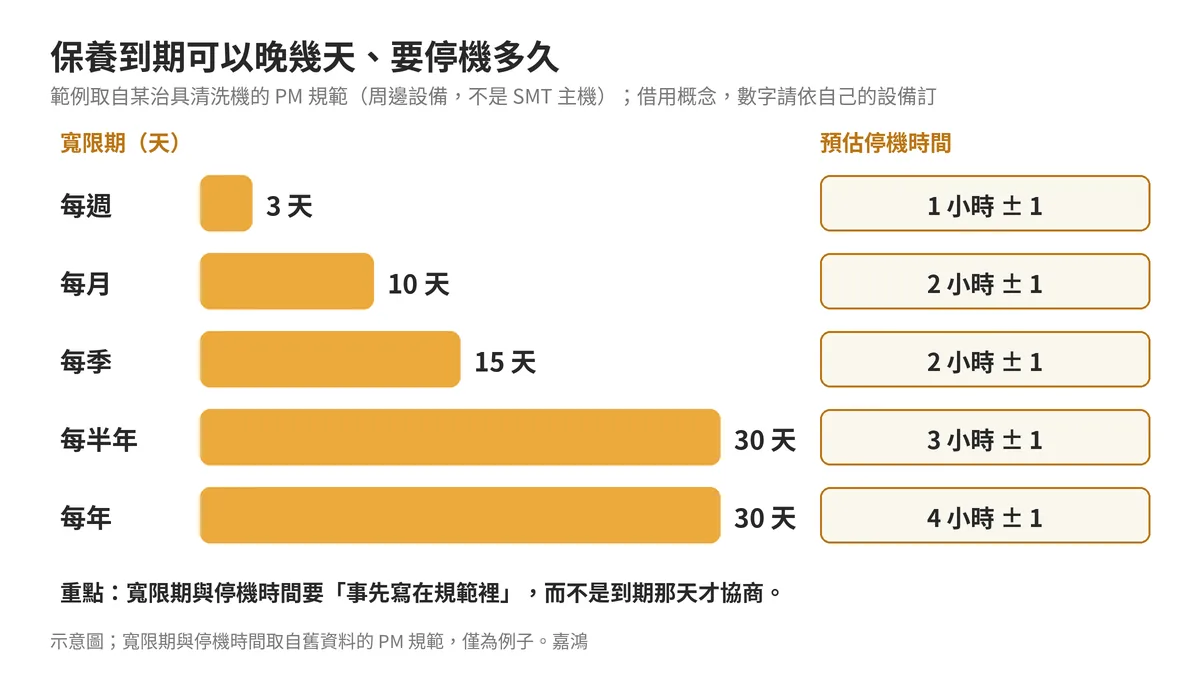
Schematic: grace period and estimated downtime (numbers from one fixture cleaning machine specification, as an example).
Weekly maintenance grace 3 days, monthly 10 days, quarterly 15 days, half-yearly and yearly 30 days; estimated downtime in the same order 1, 2, 2, 3 and 4 hours (each ± 1 hour). Please do not copy the numbers directly, but the structure of “grace period plus downtime both written into the specification” is worth copying: items with a short grace period are the ones done often, and long ones are the major services that need downtime scheduled. The 2013 equipment section weekly report follows the same line of thought, recording PM man-hours by level; in one week a printer on one line took about 1.2 hours, and a mounter about 1.2 to 2.3 hours each, giving a basis for scheduling manpower and downtime windows (the models differ from today’s, and the numbers are used just as a format reference).
The grace period has also been written about externally: an August 2026 article in Reliable Media defines PM compliance as the proportion of due preventive maintenance tasks completed within the completion standard the organization itself sets; and says the completion standard can require completion before the due date, or allow a grace window; the window should be set by yourself, written down and applied consistently, and if the equipment maker’s or the regulator’s requirement is stricter, the stricter one governs (Reliable Media: PM compliance; the article gives no fixed number of grace days or target percentage).
There is one more: a mandatory stop. The older oven specification says it plainly: when a machine abnormality affects product quality it must be stopped. We suggest also writing one line on the schedule: in which situations you must not push on with production, and who decides to stop.
6. Step 5: linking the schedule to spare parts
Q: How do I link the schedule to spare parts? A: For items that change parts, write “what to change and how many” on the sheet, and at month end work out next month’s spares from the records. The 2013 weekly report has a filter material requisition that is very concrete: 20 pieces of mounter filter material left, 22 mounters in all, 10 pieces needed per machine, monthly maintenance replaces them according to damage and dirt of the filter, about 30 to 50 pieces a month, and the control method is “track replacement from the equipment’s monthly maintenance records”. Among the requisitioned items of the same report there are also grease for mounter monthly maintenance, filter material for the reflow oven, and Teflon tape for reflow oven quarterly maintenance — behind every box of maintenance there is a matching consumable.
Going back to the table above, the boxes directly related to consumables are: the mounter’s weekly “nozzle holder inside and outside cleaning”, monthly “nozzle tip and interior cleaning”, quarterly “transfer head filter cleaning”, and the reflow oven’s filters and filter elements. To look up part numbers, enter from the links below:
› Look up filter part numbers by model: for Panasonic, FUJI, YAMAHA and Samsung / Hanwha models see the filter part number master list
› Look up nozzle part numbers by model: for Panasonic, FUJI, YAMAHA and JUKI models, see the nozzle part number master list
When axis and belt maintenance has gone all the way and what really has to be replaced is the motor or driver, look up by model again: for the Panasonic CM602 driver see the driver part number page.
Frequently asked questions
How do I set the interval for SMT equipment maintenance?
First follow the maintenance chapter of the equipment maker’s manual, then adjust to your own output and conditions. The station specifications in the older material mostly hand the frequency to the manual; the reflow oven example also shows that the cleaning interval often relates to output and the amount of paste residue, and is not a fixed calendar number.
How are weekly and monthly items split?
A common split: cleaning and state checks that you can wipe and see go in weekly; things that need tools, such as lubrication, belts, filters, and the oven chamber and condenser, go in monthly; quarterly and yearly hold a few filters, lubrication, water tanks, and electrical and rotating parts. This is our reading of the 2009 table; the actual split depends on the model and the manual.
What should be written for each item on the maintenance schedule?
Five things: the item, how and with what tool, the pass value, what to do when exceeded, and how to record. For example, support pin height: measure with vernier calipers, 64 mm ± 0.15 mm, notify day-shift engineering if abnormal, fill in the value and sign.
Maintenance is due but the line is rushing an order; can it be put off?
How many days it can be put off must be written into the specification beforehand. The fixture cleaning machine specification in the older material gives 3 days for weekly, 10 days for monthly, 15 days for quarterly and 30 days for half-yearly and yearly maintenance; set the numbers for your own equipment, the point being to write them down and apply them consistently.
What should the maintenance records keep?
Each item is confirmed one by one at its frequency, the value is filled in or a V ticked after doing it, then signed and dated. The record sheet should let a person see at a glance how far maintenance has got; the older material has an audit finding where the mounter’s check sheet “made it hard to see the PM status” and a new version was requested.
How should maintenance consumables and spares be prepared?
Work them out from the monthly maintenance records. The example in the older material is 22 mounters with 10 pieces of filter material each, replaced at monthly maintenance by damage and dirt, about 30 to 50 pieces a month. The sheet should state, for each item, what is changed and how many.
How often does a reflow oven need its flux cleaned?
There is no fixed answer. The 2009 table puts oven chamber and condenser cleaning in the monthly box; a maker’s paper carried on the IPC website gives every 4 weeks for a high-volume nitrogen line. The actual interval depends on output and solder paste; adjust by the manual and your own observation.
In which box of the schedule do nozzles and filters go?
By the 2009 table: for the mounter, weekly maintenance cleans the inside and outside of the nozzle holder, monthly cleans the nozzle tip and interior, and quarterly cleans the transfer head filter. For your machine follow the manual; remember to put parts with a service life into the table.
Have a similar problem? Write to Jiahon and see whether there is a matching solution. We offer quick online consultation; with one more party to discuss with, we will take part as far as we can in solving the problem.